External interfaces
Eventually, something other than an adapter will need to communicate with ioBroker: a shell script, Node-RED, Grafana, a weather station, a neighbor's home automation system, or a custom-built app. Adapters exist that provide external access for this purpose.
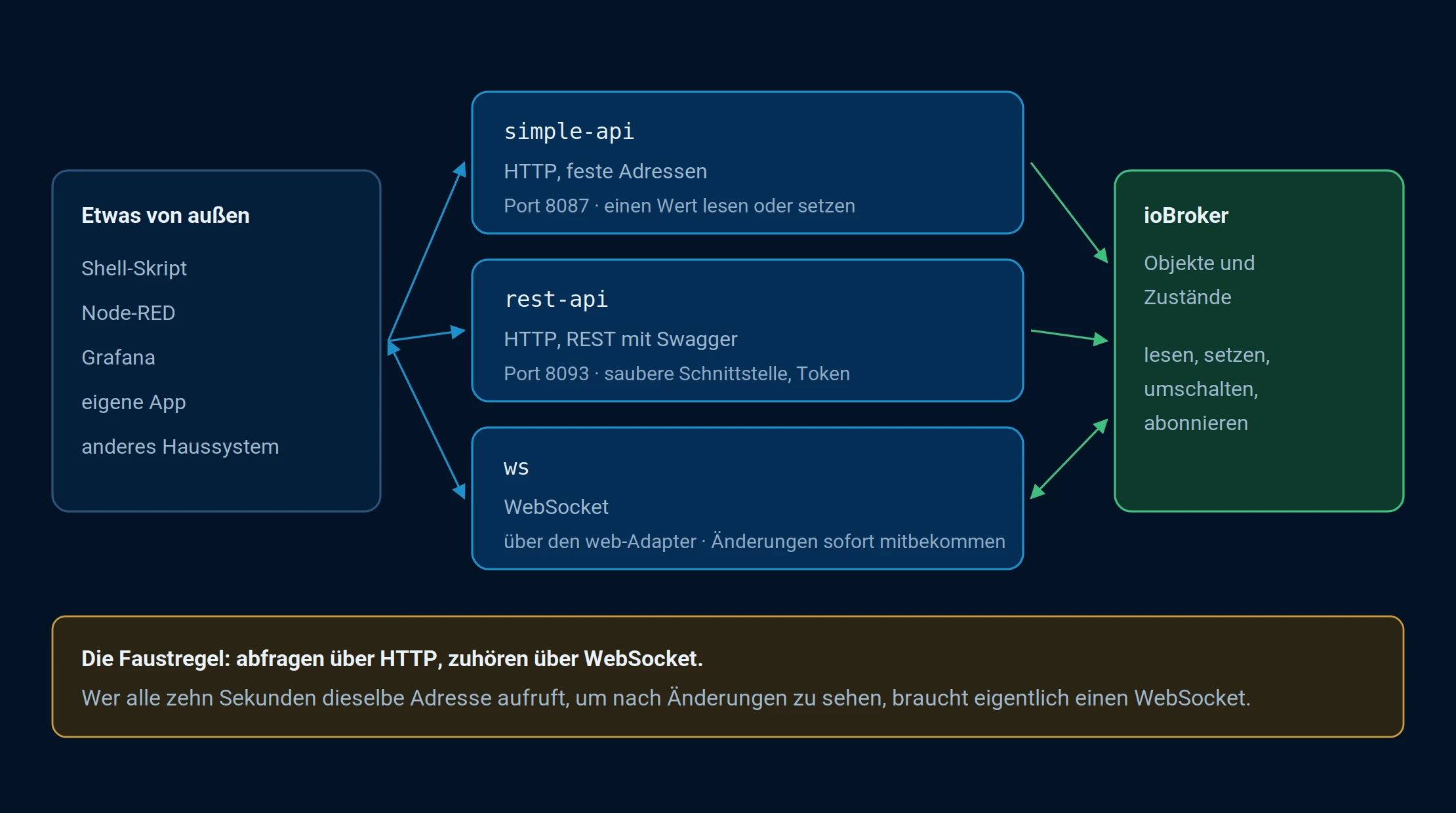
Three paths inwards. The difference lies in whether a program has to ask or learns on its own that something has changed.
Which access
| adapter | Art | Port from factory | Good for |
|---|---|---|---|
| simple-api | HTTP, static addresses | 8087 | Reading or setting a value from a script or a browser |
| rest-api | HTTP, REST with Swagger | 8093 | Programs that expect a clean interface, with login via tokens |
| ws | WebSocket | on theweb -Adapter | Applications that should detect changes immediately without asking. |
The rule of thumb: query via HTTP, listen via WebSocket. Anyone who calls the same address every ten seconds to see if anything has changed really needs a WebSocket.
simple-api
The easiest access. After creating an instance, it delivershttp://<adresse>:8087/help The list of possible calls. The most important ones:
http://<adresse>:8087/getPlainValue/<id>        nur der Wert, als Text
http://<adresse>:8087/get/<id>                  der Zustand als JSON
http://<adresse>:8087/getBulk/<id1>,<id2>       mehrere auf einmal
http://<adresse>:8087/set/<id>?value=1          einen Wert setzen
http://<adresse>:8087/toggle/<id>               umschalten
http://<adresse>:8087/setBulk?<id1>=0.7&<id2>=0 mehrere setzen
http://<adresse>:8087/states?pattern=hm-rpc.0*  Zustände suchen
http://<adresse>:8087/objects?pattern=hm-rpc.0* Objekte suchen
Appended to a call, formatted?prettyPrint The output is readable. This allows you to try everything out in the browser before it's incorporated into a script.
?>getPlainValue It returns only the value, without quotation marks or parentheses. That's exactly what a shell script needs to pass the value on.
The progress can also be viewed if a recording is in progress:
http://<adresse>:8087/query/<id>?dateFrom=2026-09-01T00:00:00.000Z&aggregate=minmax&count=2000
rest-api
The more modern approach. A call fromhttp://<adresse>:8093/ opens a Swagger interface where all calls can be tried out without having to look them up first.
http://<adresse>:8093/v1/state/<id>             Zustand als JSON
http://<adresse>:8093/v1/state/<id>/plain       nur der Wert
http://<adresse>:8093/v1/sendto/javascript.0    eine Nachricht an eine Instanz
http://<adresse>:8093/v1/command/<name>         einen Befehl ausführen
States can also be subscribed to , and viahttp://<adresse>:8093/oauth/token Is there a login option using a token instead of a username and password in the address?
ws
WebSocket access. It is not accessed directly, but rather used by an application that establishes a persistent connection and is notified of changes instead of requesting them. vis and echarts retrieve their data this way.
Since version 4, the adapter works with pure WebSockets; socket.io is only emulated. An example is available in the repository .
Security
These adapters grant access to your data points, and without registration, access is open to anyone who knows the address. This might be sufficient within your own network, but not beyond.
Three things are required before an interface extends beyond the home network:
- Enable login on the relevant instance. See Authentication .
- Creating a separate user with only the rights required by the calling program is not possible.
adminSee Access Management . - Encrypt your connection; otherwise, your login credentials will be transmitted in plaintext. See Encryption .
!> Atsimple-api The username and password are included in the address and therefore end up in logs and the browser's history list. This is relevant for external access.rest-api Tokens are the better choice.
Making it accessible remotely is possible without an open port via the IoT adapter . Port forwarding to one of these interfaces is the worst of the possible solutions.
The reverse way
If the data is not to be queried but reported , i.e., an external system sends something to ioBroker, other methods are possible:
- MQTT via the adapter of the same name, if the other system supports it.
- URL services via the cloud are used when the message originates from the internet and no port should be opened. See Services .
- simple-api with
set, if the foreign system can simply access an address.