System structure
architecture
ioBroker is modular, meaning it's built from many individual components. Each module has a specific task. To maintain an overview, ioBroker therefore has a central coordinator for all its modules. This coordinator works in the background.js-controller He is responsible for central data storage as well as management and communication between all modules. The modules themselves areAdapter These are called adapters. The user only installs them when needed. The web-based administration interfaceadmin The Admin adapter itself is also an adapter. The Admin adapter, or simply "Admin," is the management interface of an ioBroker system. The Admin is typically accessed via the address http://localhost:8081 .
When a new adapter is installed using the administrator account, the adapter files are first downloaded from the internet and written to the server's hard drive. If an adapter is to be started, aInstanz The adapter is generated. Each adapter instance can be individually configured and independently stopped and started by the administrator. Therefore, each instance runs in its own process, which communicates with the ioBroker js-controller in the background.
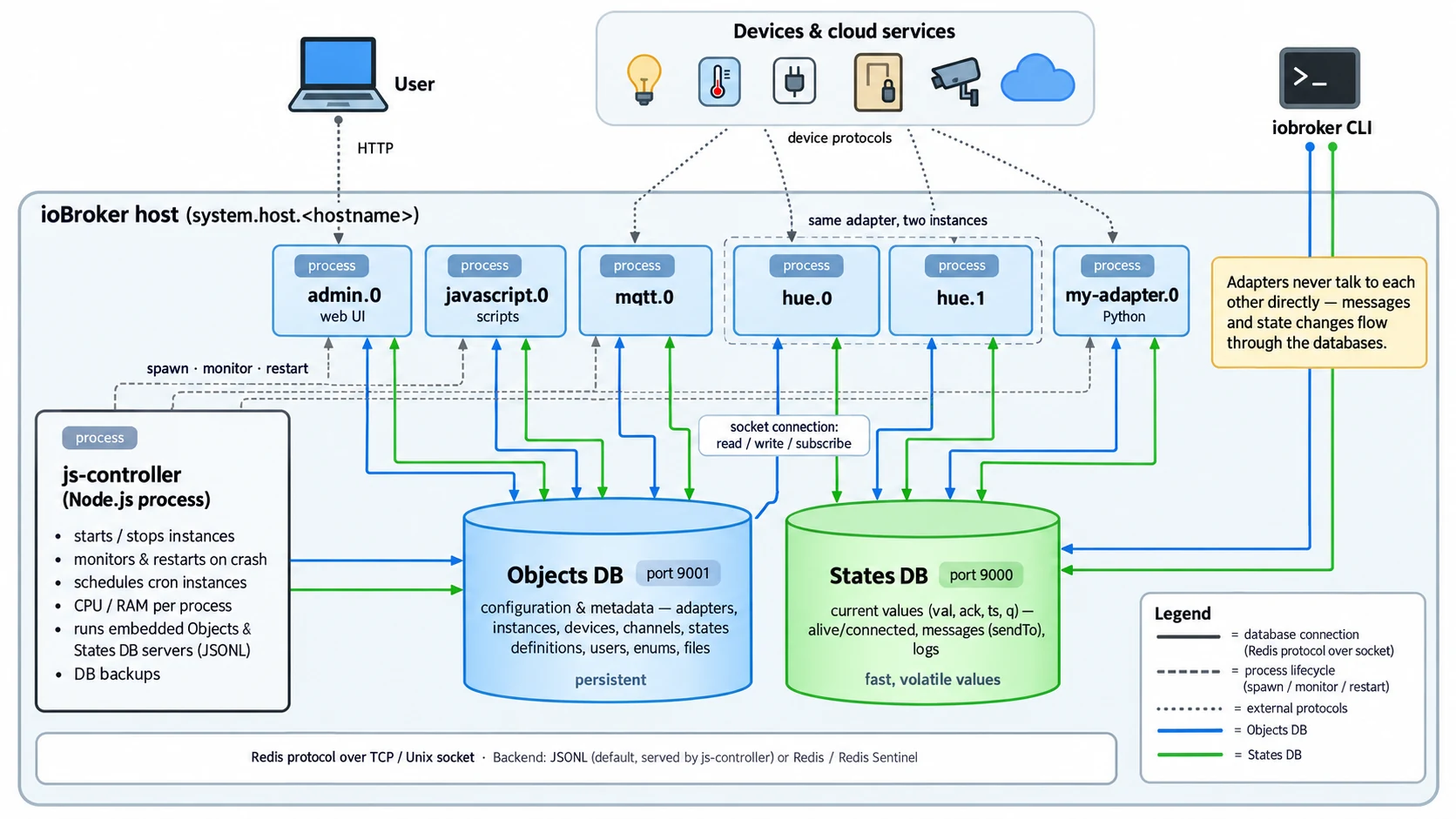
An overview of an ioBroker host: the js-controller starts and monitors the instances, each instance runs in its own process, and everything exchanged between them goes through the two databases. Adapters never communicate directly with each other.
In aMultihost In systems with multiple ioBroker servers, adapter instances can be distributed across different servers. This allows for load distribution or the direct connection of additional hardware on-site (e.g., I/O ports, USB).
Communication between adapters, JS controllers, databases, and web frontends takes place via multiple TCP/IP connections. Depending on the selected settings, data exchange occurs either in plaintext or encrypted.
ioBroker and its adapters are primarily written in the JavaScript programming language. To execute JavaScript, a suitable runtime environment is required. ioBroker therefore relies on Node.js. This runtime environment is available for various software platforms such as Linux, Windows, and macOS.
To install ioBroker and the adapters, the Node Package Manager, or Node Package Manager for short, is used.npm Node.js is used. It can search for, install, remove, compile, and update modules and their dependencies. ioBroker does not function without Node.js. Manual installation of Node.js is not necessary; the ioBroker installer handles this automatically.
As is common with many open-source technologies, Node.js is evolving rapidly. Minor updates that improve stability and security, or even add new features, are released regularly.
Node.js versions with even major version numbers become LTS (Long Term Support) versions after a few months and are then maintained for several years. A new version is released each year, and at the same time, an older version reaches its end of life (EOL) – after which it no longer receives security updates. Odd major versions are pre-release versions and are not suitable for ioBroker.
For ioBroker, this means that a specific recommended LTS version always applies, and versions released after their end of life are no longer supported by the adapters and later by the js-controller. Information on which version is currently recommended and how to switch can be found under Updating Node.js & npm .
Adapter and instance
Adapters are special modules that integrate various devices, services, or protocols into the ioBroker system. They act as interfaces between ioBroker and the external systems you control or from which you collect data. Adapters can be categorized in various ways, such as device adapters, protocol adapters, service adapters, database adapters, visualization adapters, script adapters, and specialty adapters.
Each adapter instance can be individually configured and independently stopped and started by the administrator. This enables flexible and scalable integration of various devices and services into the ioBroker system. Adapter instances run in their own processes and communicate with the js-controller in the background.
Multi-host systems
In a multi-host system, multiple ioBroker servers can be connected to distribute the load or to integrate additional local hardware. This enables better scalability and flexibility of the ioBroker system. Adapter instances can be distributed across different servers to optimize system resource utilization.
Communication between the servers takes place via TCP/IP connections, and data exchange can be either plaintext or encrypted, depending on the configuration. Multi-host systems offer a robust and scalable solution for large installations with many devices and services.
Security and updates
Security and regular updates are crucial aspects of using ioBroker. Node.js, the underlying runtime environment, is rapidly evolving and receives regular updates that improve stability and security. It's important to use the LTS (Long Term Support) versions of Node.js, as these are maintained and receive security updates for a longer period.
ioBroker and its adapters utilize many modules and extensions from the JavaScript open-source community. It is important to update these modules regularly to benefit from the latest security and stability improvements. The Node Package Manager (npm) simplifies the management and updating of these modules.
Summary
ioBroker is a modular and scalable system for integrating and controlling various devices, services, and protocols. The central coordinator, the js-controller, manages the adapters and ensures communication between the system's various components. Adapters enable flexible integration of devices and services, and multi-host systems offer additional scalability and flexibility. Security and regular updates are crucial for ensuring the stability and reliability of the ioBroker system.