SENEC Adapter for ioBroker
Monitor and control your SENEC home battery storage system. The adapter supports four independent connectors that can be used individually or combined:
- Local (lala.cgi) — Direct LAN polling with 10-second real-time updates. Provides full BMS data, grid meter readings, wallbox data, and appliance control.
- SENEC App API — Cloud-based polling via the SENEC App API. Dashboard data, measurement history, system details, and wallbox information.
- mein-senec.de — Web portal polling. Status overview, measurement history, autarky, emergency power, peak shaving, SG-Ready, and switchable socket control.
- SENEC.Connect — Azure-based API. Battery and meter data via subscription key.
Not all connectors are required. Choose based on your needs — local-only setups work fine, as do cloud-only configurations for systems without local web access.
Supported Systems
Practically every SENEC storage system works: the Home range from the early lead-acid and lithium models through V2, V2.1 and V3, the current V4 | P4 | E4 generation, the Business models, and the partner variants ADS Tec, OEM LG and Solarinvert.
Systems with a local web interface can use all four connectors. Those without one — the V4 generation among them — work through the SENEC App API, mein-senec.de and SENEC.Connect. Which data points appear varies by model.
See the full list of models to find your system by name.
Disclaimer
All product and company names or logos are trademarks™ or registered® trademarks of their respective holders. Use of them does not imply any affiliation with or endorsement by them or any associated subsidiaries! This personal project is maintained in spare time and has no business goal.
No warranty, and no liability. This adapter is a spare-time project, provided as-is under the MIT license. It talks to an expensive appliance over interfaces SENEC neither documents nor supports, and it can send commands that change how that appliance behaves. Everything you do with it is your own responsibility. The author accepts no liability for damage to your system, lost or wrong data, missed feed-in, or any other consequence of using it — and cannot tell you whether using it affects your warranty or support arrangements with SENEC or your installer. If that is not acceptable to you, please do not use this adapter.
Prerequisites
- ioBroker with Node.js >= 22
- SENEC battery system on the local network (for Local connector)
- mein-senec.de account (for API and Web connectors)
- ioBroker.web adapter installed (for the built-in dashboard)
Installation
Install the adapter from the ioBroker adapter repository. After installation, create an adapter instance and configure at least one connector.
Configuration
The adapter settings are organized in tabs — one per connector plus general settings and debug options.
SENEC Account
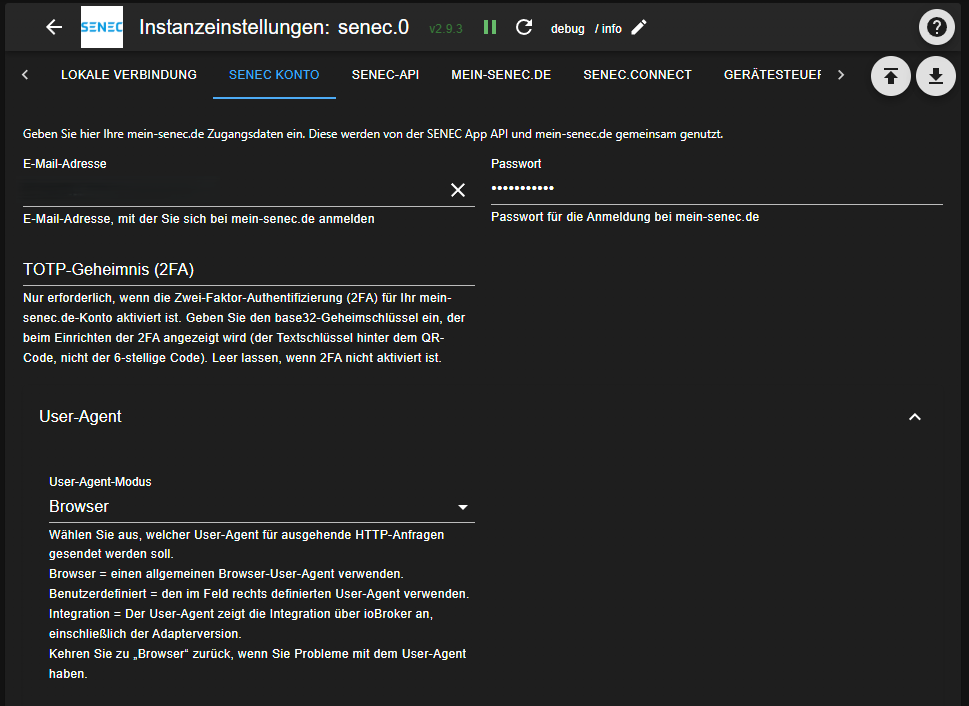
Enter your mein-senec.de credentials here. These are shared by the SENEC App API and mein-senec.de connectors. You can also configure the User-Agent mode for outbound HTTP requests.
Two-Factor Authentication (2FA)
If two-factor authentication is enabled on your mein-senec.de account, the adapter can log in on its own — it does not need you to be there to type a code.
Enrolment shows a QR code for your authenticator app and, next to it, the same secret as text. That text secret is what goes into the TOTP Secret field. Take it from the setup screen while it is on display; once 2FA is active the secret is not shown again, and you would have to re-enrol to see a new one. Spaces and dashes in it do not matter.
What belongs there is the permanent secret, not the six-digit code your app shows — that changes every thirty seconds and would be stale before the adapter ever used it.
One secret covers both cloud connectors, since they authenticate against the same account. If 2FA is required and the field is empty, the adapter says so plainly in the log rather than reporting a failed login.
Local Connection (lala.cgi)
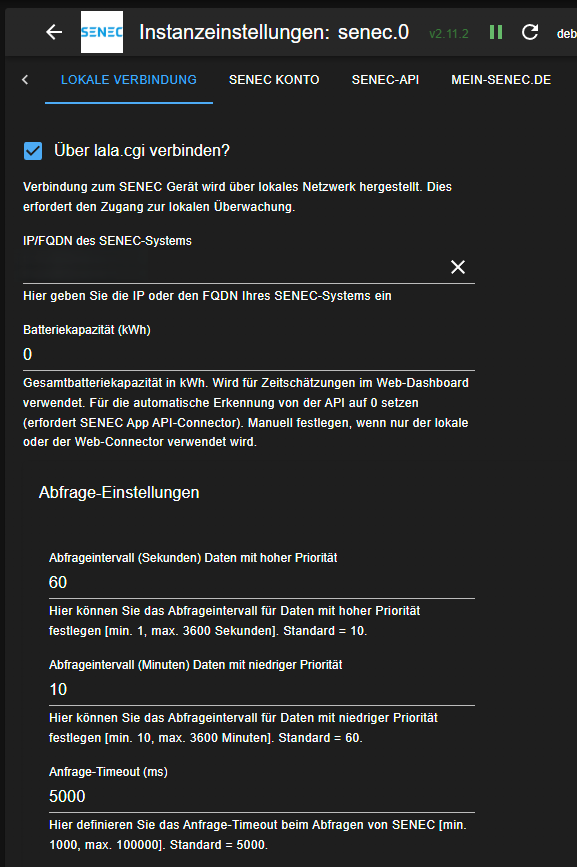
| Setting | Description | Default |
|---|---|---|
| Connect via lala.cgi | Enable local polling | On |
| SENEC System IP | IP address or FQDN of your SENEC device | — |
| Use HTTPS | Enable if your device uses HTTPS | Off |
Expand Polling Settings to adjust timing:
| Setting | Description | Default |
|---|---|---|
| Polling interval (high priority) | How often to poll real-time data (seconds) | 10 |
| Polling interval (low priority) | How often to poll slow-changing data (minutes) | 60 |
| Request timeout | Timeout for HTTP requests (ms) | 5000 |
The adapter retries automatically with exponential backoff on connection failures — no manual retry configuration needed. If the SENEC device is temporarily unreachable (reboot, firmware update), polling resumes automatically when the device comes back online.
TLS Certificate Validation
The adapter validates the SENEC device's HTTPS certificate using a multi-layer approach:
- User CA — Upload the SenecGui-Root CA certificate via the dashboard (System tab → TLS Certificate). Download it from mein-senec.de (Documents / General Documents / SenecGui-Root) and upload the .pem or .zip file. SENEC distributes this certificate behind a login, so the adapter cannot bundle it.
- Cached CA — If no user cert is provided, the adapter can automatically download the CA from mein-senec.de (requires the mein-senec.de connector to be enabled). The downloaded cert is cached in adapter state and persists across restarts.
- TOFU (Trust On First Use) — If no CA cert validates, the adapter records the device's certificate fingerprint on first contact and compares every later connection against it. A warning is logged if the fingerprint changes (e.g. after a firmware update), and the new fingerprint is then accepted automatically.
The adapter tries each layer in order and uses the first one that validates.
TOFU is continuity monitoring, not certificate pinning: it tells you that the appliance's certificate changed, but it does not refuse the new one, and it does not verify the certificate chain. It is a deliberate trade-off for a device on your own network — a legitimate certificate change must never leave the adapter disconnected until you notice a log line. For full verification, supply the CA: uploading it is optional but it is the stronger option.
If automatic CA download failed and you want to retry, set _local.tls.certFetchFailed to false — the adapter will attempt the download again on the next restart or immediately if running.
Important: Polling too frequently or requesting too many data points can overload your SENEC device. This may cause the device to restart, become unresponsive, or fail to synchronize with the SENEC cloud. If you experience issues, reduce the polling frequency or stop the adapter.
Additional High-Priority Polling Data Points
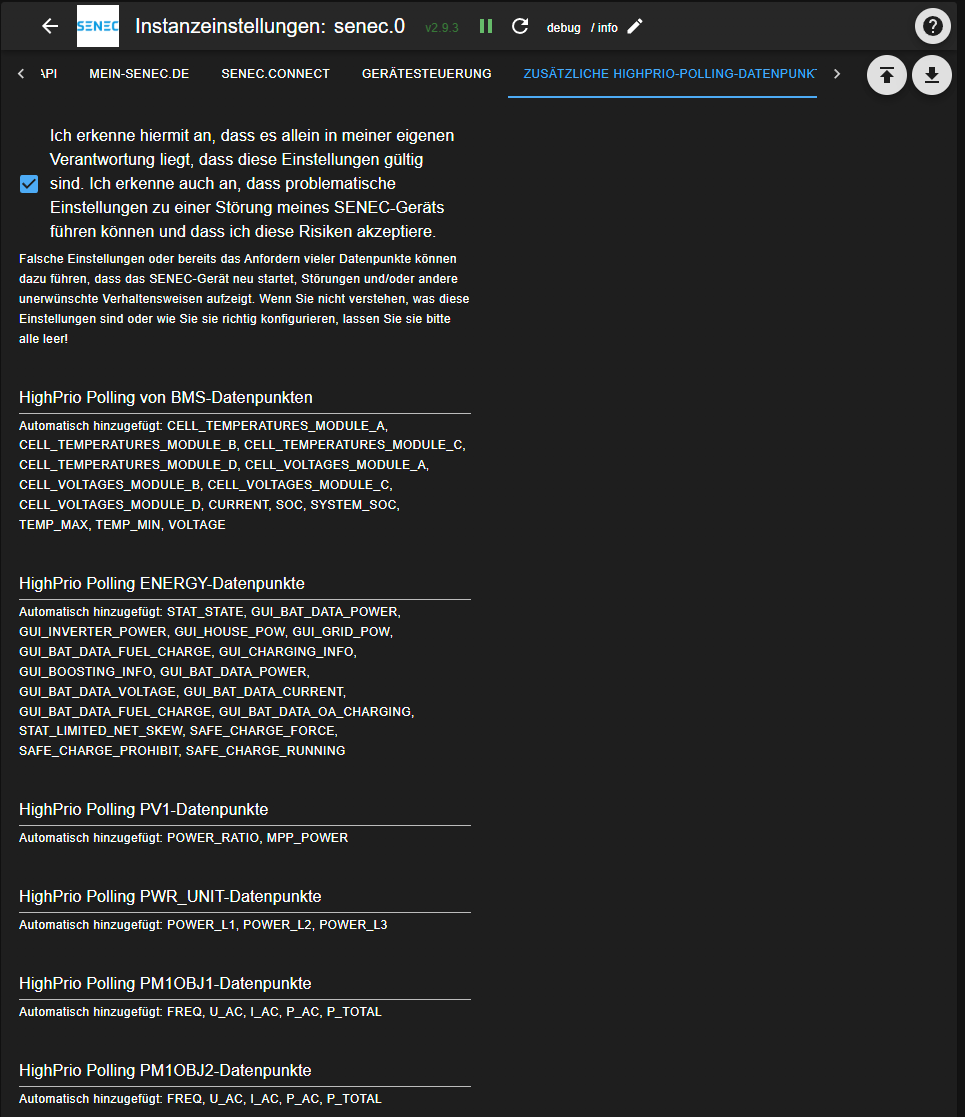
You can add additional data sections (e.g. BMS, PV1, WALLBOX) to the high-priority polling cycle. This requires accepting a disclaimer acknowledging the risks. Only characters A-Z, digits 0-9, and commas are allowed.
SENEC App API
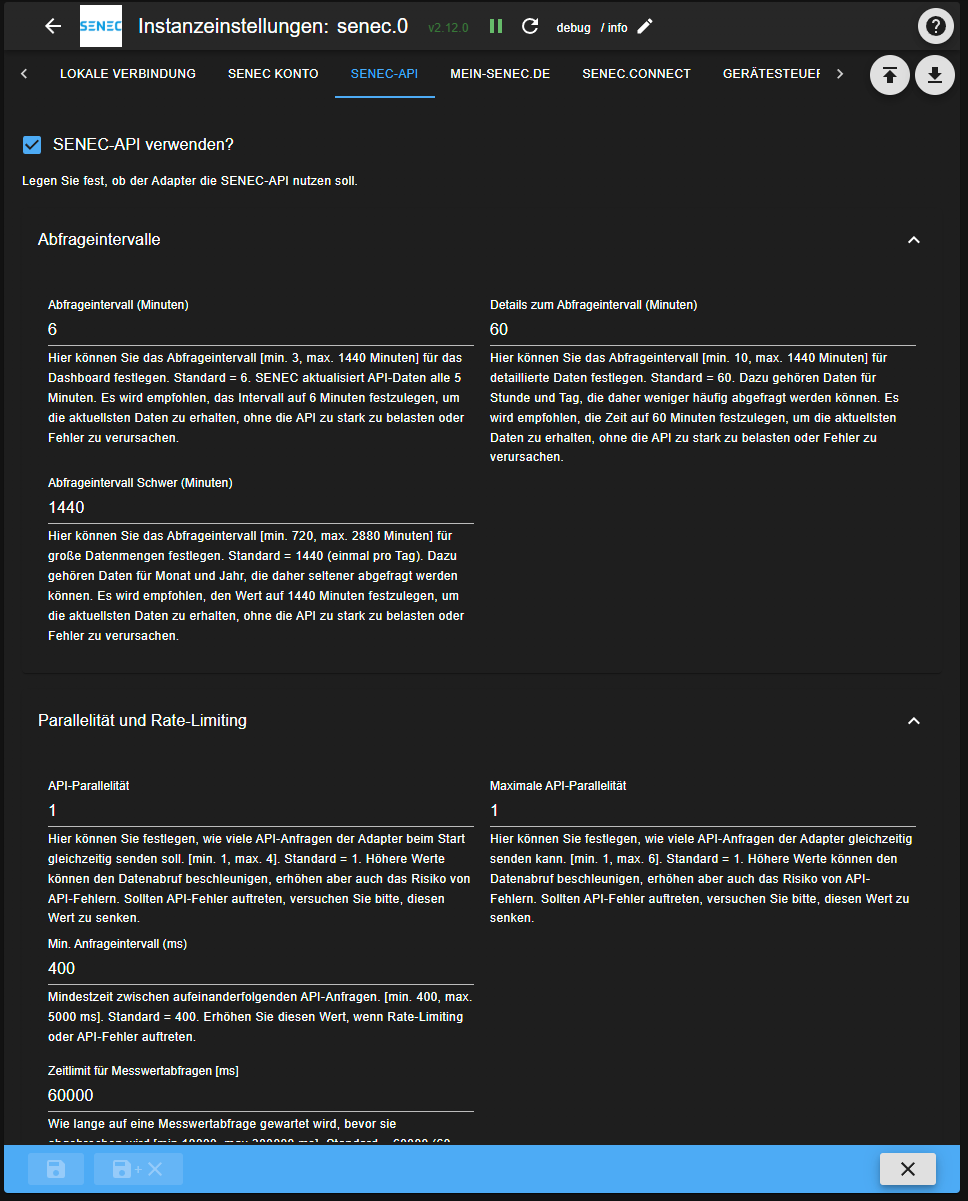
| Setting | Description | Default |
|---|---|---|
| Use SENEC App API | Enable cloud API polling | Off |
| Dashboard interval | Polling interval for dashboard/current data (minutes) | 6 |
| Details interval | Polling interval for day-level measurement data (minutes) | 60 |
| Heavy interval | Polling interval for month/year measurements (minutes) | 1440 (24h) |
| Concurrency / Max concurrency | Parallel API request limits | 1 / 1 |
| Min request interval | Minimum time between API requests (ms) | 400 |
| API request timeout | How long to wait for an ordinary API request — dashboard, system status, details (ms). Raise it if the log shows those requests timing out | 30000 |
| Measurement request timeout | How long to wait for a measurement aggregation (ms). Raise it if the log shows heavy polls timing out | 60000 |
History Rebuild
The API connector can rebuild historical measurement data (AllTime totals) from scratch. Configure the rebuild mode and start year if needed. This runs as a background process during the heavy polling tier.
mein-senec.de
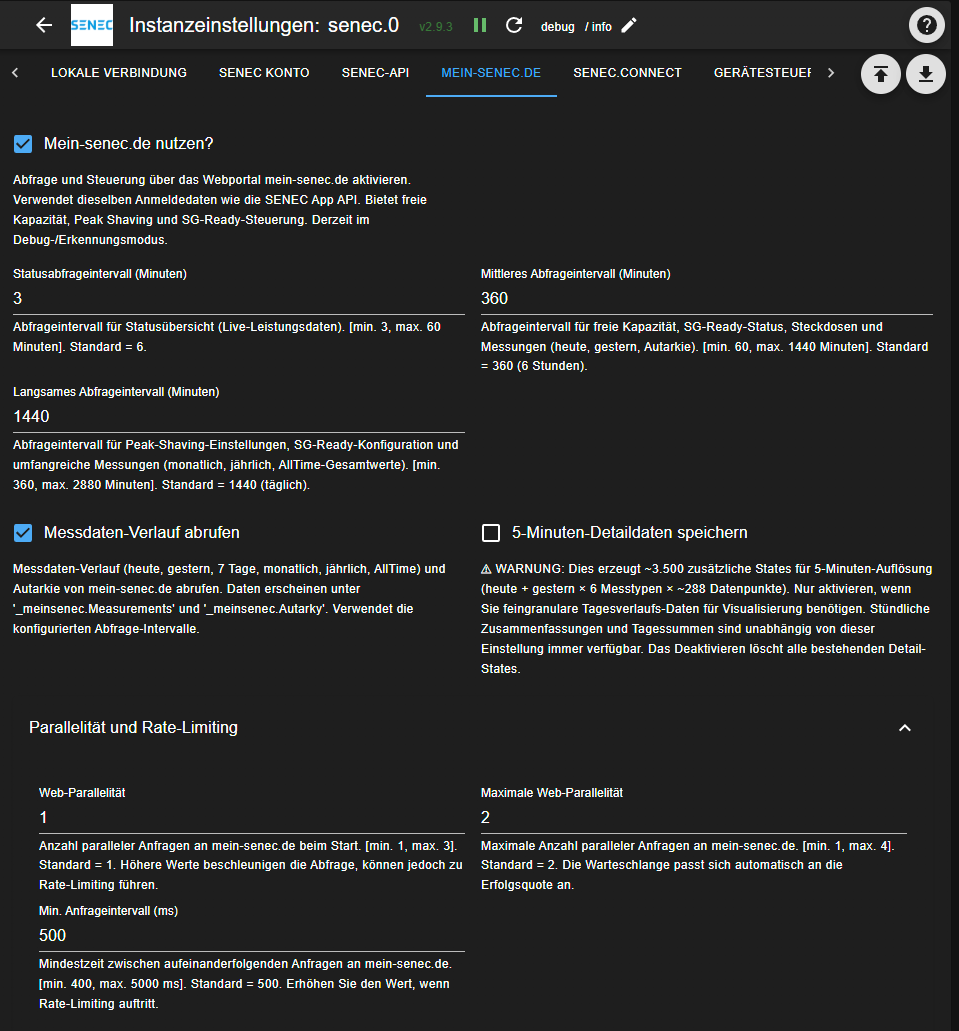
| Setting | Description | Default |
|---|---|---|
| Use mein-senec.de | Enable web portal polling | Off |
| Status interval | Polling interval for status data (minutes) | 6 |
| Medium interval | Polling interval for yesterday/autarky/spare capacity (minutes) | 360 (6h) |
| Slow interval | Polling interval for monthly/yearly/AllTime data (minutes) | 1440 (24h) |
| Poll measurement history | Enable measurement data polling | Off |
| Include 5-min detail data | Poll fine-grained detail data (~3,500 additional states) | Off |
| Concurrency / Max concurrency | Parallel request limits | 1 / 2 |
| Min request interval | Minimum time between requests (ms) | 500 |
Additional Systems on the Account
If your mein-senec.de account holds more than one system — a replaced appliance still shows up alongside its successor — the adapter discovers all of them at startup and registers each under _meinsenec.Plants.{steuereinheitnummer}..
Only the first system is polled by default. Each additional one gets its own switch at control.Plants.{steuereinheitnummer}.poll, off until you set it. Turning it on adds that system to the slow polling tier, filling the same measurement structure the main system uses:
| State | Contents |
|---|---|
_meinsenec.Plants.{sn}.System.* | Product name, device number, plant number |
_meinsenec.Plants.{sn}.Measurements.Daily.today / .yesterday | Hourly measurement data |
_meinsenec.Plants.{sn}.Measurements.Monthly.* | Daily breakdown per month |
_meinsenec.Plants.{sn}.Measurements.Yearly.* | Monthly breakdown per year |
_meinsenec.Plants.{sn}.Measurements.AllTime.* | Lifetime totals |
_meinsenec.Plants.{sn}.Autarky.* | Autarky per period |
Lifetime totals are fetched once when a system is first discovered, even with the switch off, so a decommissioned appliance's final figures are available without polling it continuously.
Bear in mind that each enabled system multiplies the requests made to the portal. If you only want the historical totals of an old appliance, leaving its switch off is usually enough.
SENEC.Connect
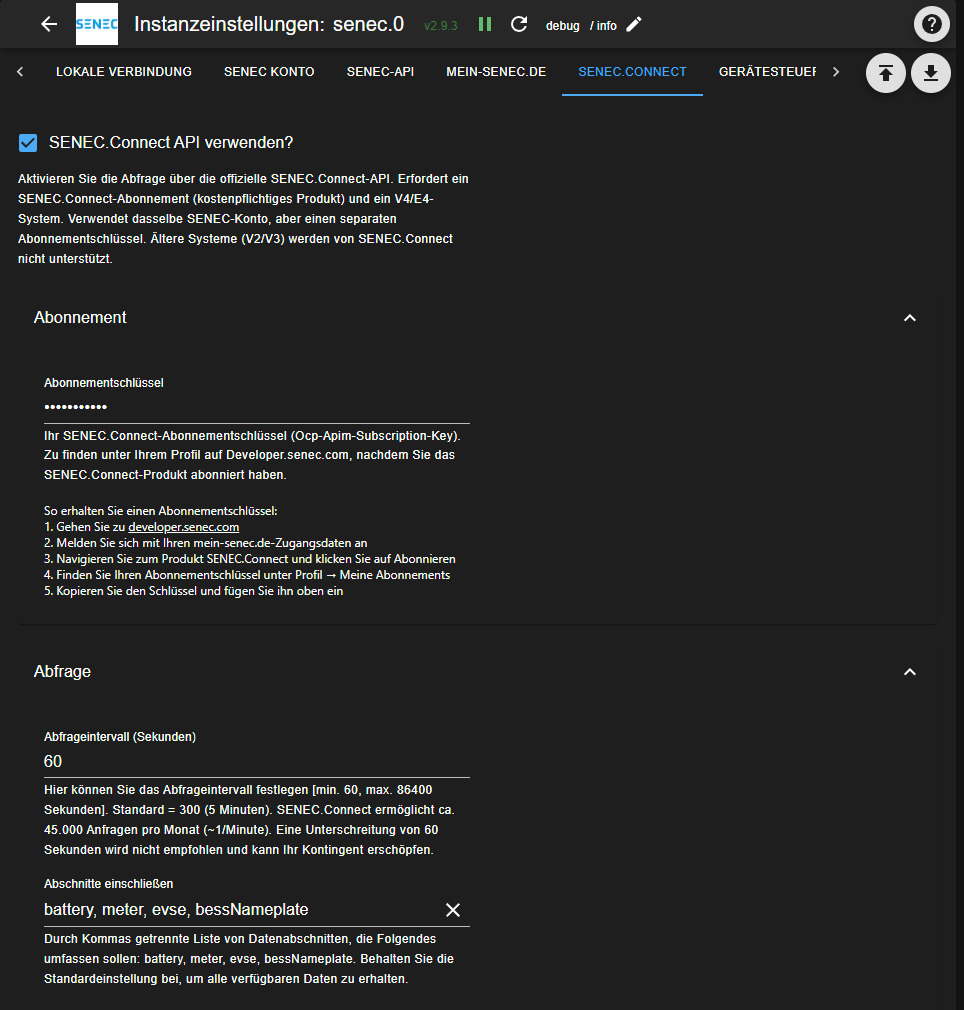
| Setting | Description | Default |
|---|---|---|
| Use SENEC.Connect | Enable Azure API polling | Off |
| Polling interval | How often to poll (seconds) | 300 |
| Request timeout | How long to wait for a response (ms) | 30000 |
| Subscription key | Azure API subscription key | — |
| Include sections | Which data sections to request | battery,meter,evse,bessNameplate |
External Sources
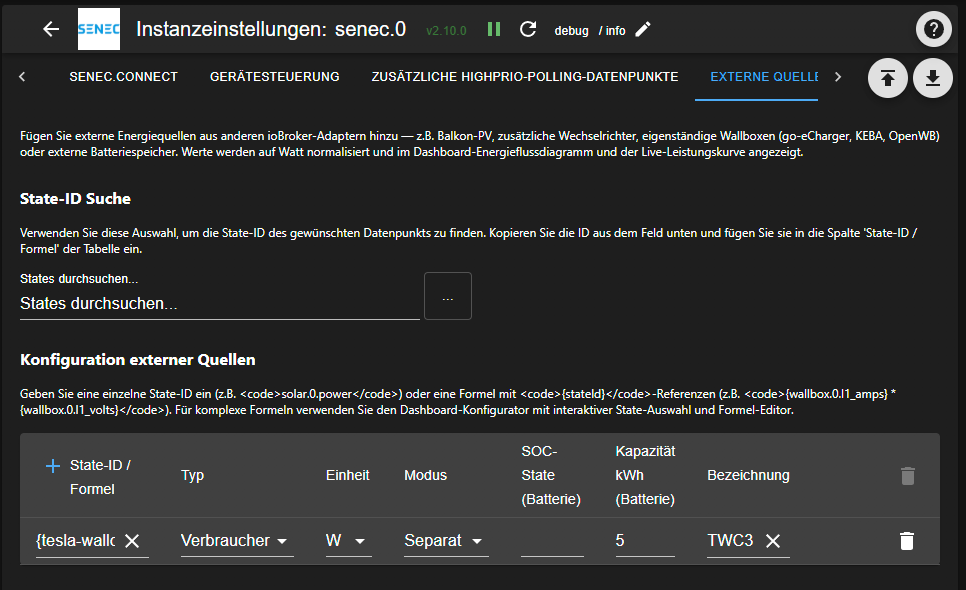
Add external energy sources from other ioBroker adapters — e.g. balcony PV, additional inverters, standalone wallboxes, heat pumps, or external battery storage. Values are normalized to Watts and shown in the dashboard energy flow diagram and live power chart.
Use the State ID Lookup picker to find the state ID of the datapoint you want to use, then paste it into the table.
| Column | Description |
|---|---|
| State ID / Formula | Single state ID (e.g. solar.0.power) or formula with {stateId} references (e.g. {wallbox.0.l1_amps} * {wallbox.0.l1_volts}) |
| Type | PV, Consumer (wallbox, heat pump, etc.), or Battery |
| Unit | W or kW — applied to the final value |
| Mode | Integrate = add to SENEC total (single node). Separate = show as individual node in energy flow |
| SOC State | (Battery only) State ID for the charge level (%) |
| Capacity | (Battery only) Battery capacity in kWh — enables time estimates |
| Label | Display name shown on the energy flow diagram |
Formulas support + - * / ( ) operators. State IDs without curly braces are auto-detected if they contain math operators. For complex formulas, a dashboard-based configurator with interactive state pickers is planned.
Appliance Control
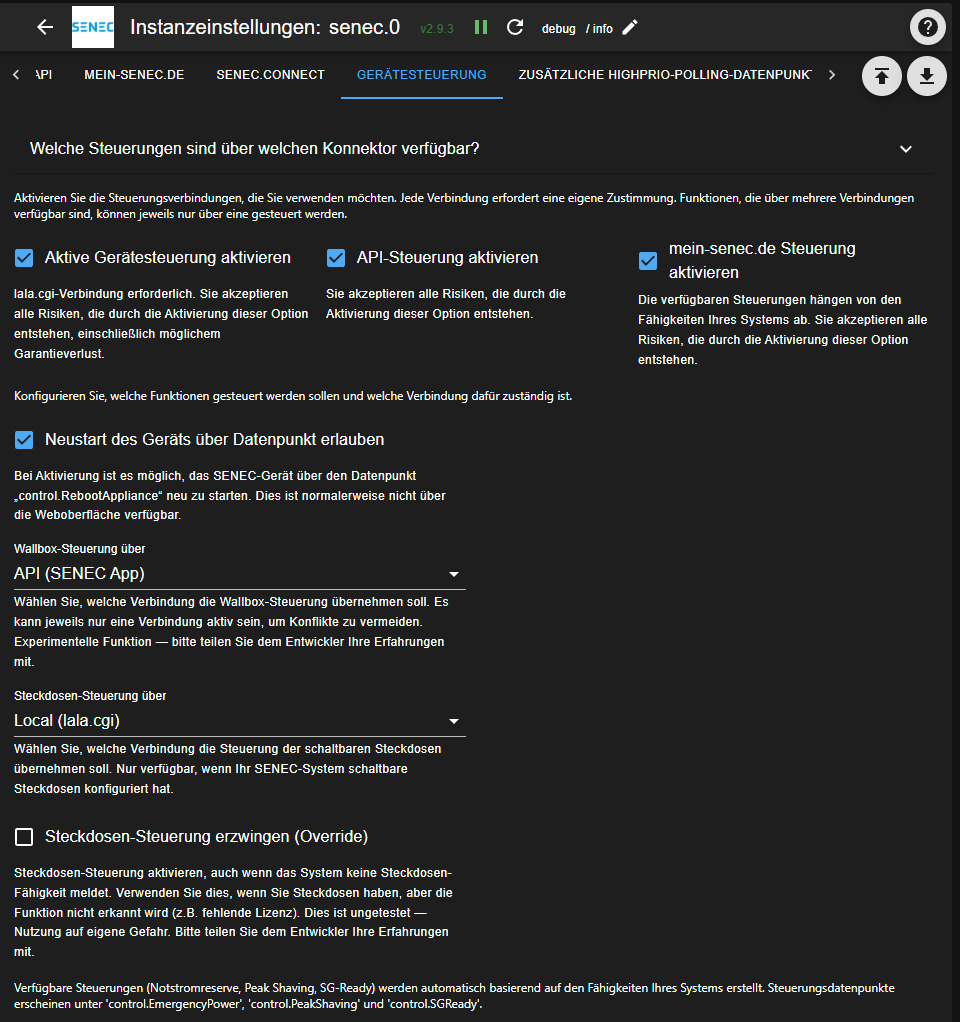
Control features allow you to change settings on your SENEC device. Each control is available via specific connectors:
| Control | Local | API | Web |
|---|---|---|---|
| Force battery charging | x | ||
| Block battery discharge | x | ||
| Appliance reboot | x | ||
| Emergency power reserve | x | ||
| Peak shaving | x | ||
| SG-Ready | x | ||
| Switchable sockets | x | x | |
| Wallbox control | x | x |
Use at your own risk. Control features must be explicitly enabled in the settings with a disclaimer acknowledgment. The adapter does not protect against conflicting commands from multiple connectors.
Debug & Logging
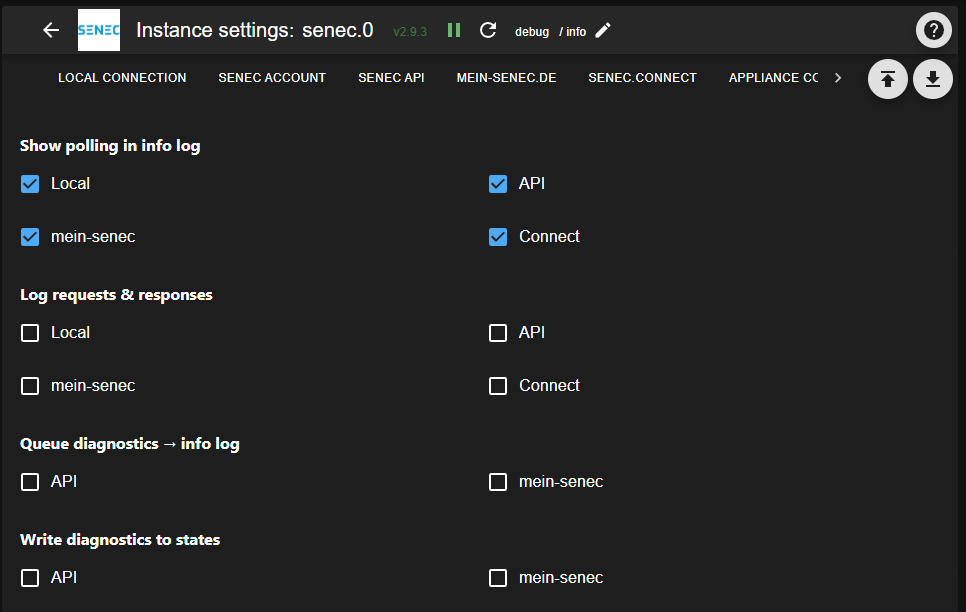
Configurable per connector (Local, API, mein-senec.de, Connect):
- Show polling in info log — Promotes polling status messages from debug to info level
- Log requests & responses — Logs HTTP details at debug level (may log sensitive data)
- Queue diagnostics to info log — Promotes queue statistics to info level (API + Web only)
- Write diagnostics to states — Writes queue data to dedicated ioBroker states (API + Web only)
Collecting a Debug Log
Most problems become obvious from a log, and almost none are diagnosable without one.
- Set the instance log level to debug: ioBroker admin → Instances → the senec instance → the log level dropdown (the wrench icon opens the instance settings; the level sits in the row itself).
sillyexists too, but it is rarely more useful and produces a great deal of noise. - In the adapter's Debug & Logging tab, enable Log requests & responses for the connector that is misbehaving. This is the setting that turns "a request failed" into "this URL answered with this status".
- Let it run long enough to catch the problem at least once. For anything on the slow tiers — measurements, monthly or yearly data — that can mean waiting for the next cycle rather than a restart.
- Collect the log from ioBroker's Log tab, or from
/opt/iobroker/log/if you would rather have the file. - Turn the level back to info afterwards. Debug logging is verbose and will fill a disk over weeks.
Before sharing a log, read through it. Request logging includes URLs and responses, and those can contain your system ID, plant number and device serial. None of it is a password, but it is yours. Replace anything you would rather not publish.
Reporting an Issue
Issues go to GitHub. What makes one quick to act on:
- Which system — the model, and the firmware version if you have it (
_local.FACTORYand_local.SYS_UPDATEhold both when the local connector runs) - Which connectors are enabled, since the same symptom has different causes on local and cloud
- Adapter and ioBroker version, plus the Node.js version
- What you expected and what happened instead — "the battery level is missing" is actionable; "it does not work" needs a round of questions first
- The relevant part of the log, at debug level, with a few lines either side of the failure rather than the single error line
Worth knowing before you file: implausible readings usually come from the appliance rather than from the adapter. It mostly passes values through, so a temperature or state of charge that looks wrong on the dashboard will generally look just as wrong in the appliance's own web interface. Checking there first often answers the question outright — and when it does not, that comparison is itself the most useful thing you can put in the report.
Built-in Dashboard
The adapter includes a full-featured web dashboard accessible at http://<iobroker-ip>:8082/senec/. It requires the ioBroker.web adapter and appears on the ioBroker.web welcome page.
Features:
- Dark and light theme (toggle in the top bar)
- Internationalization — 11 languages, follows browser locale
- Real-time updates via socket.io state subscriptions
- Data from all connectors with source indicator badges
- Keyboard accessible (tab navigation, ARIA labels)
Overview Tab
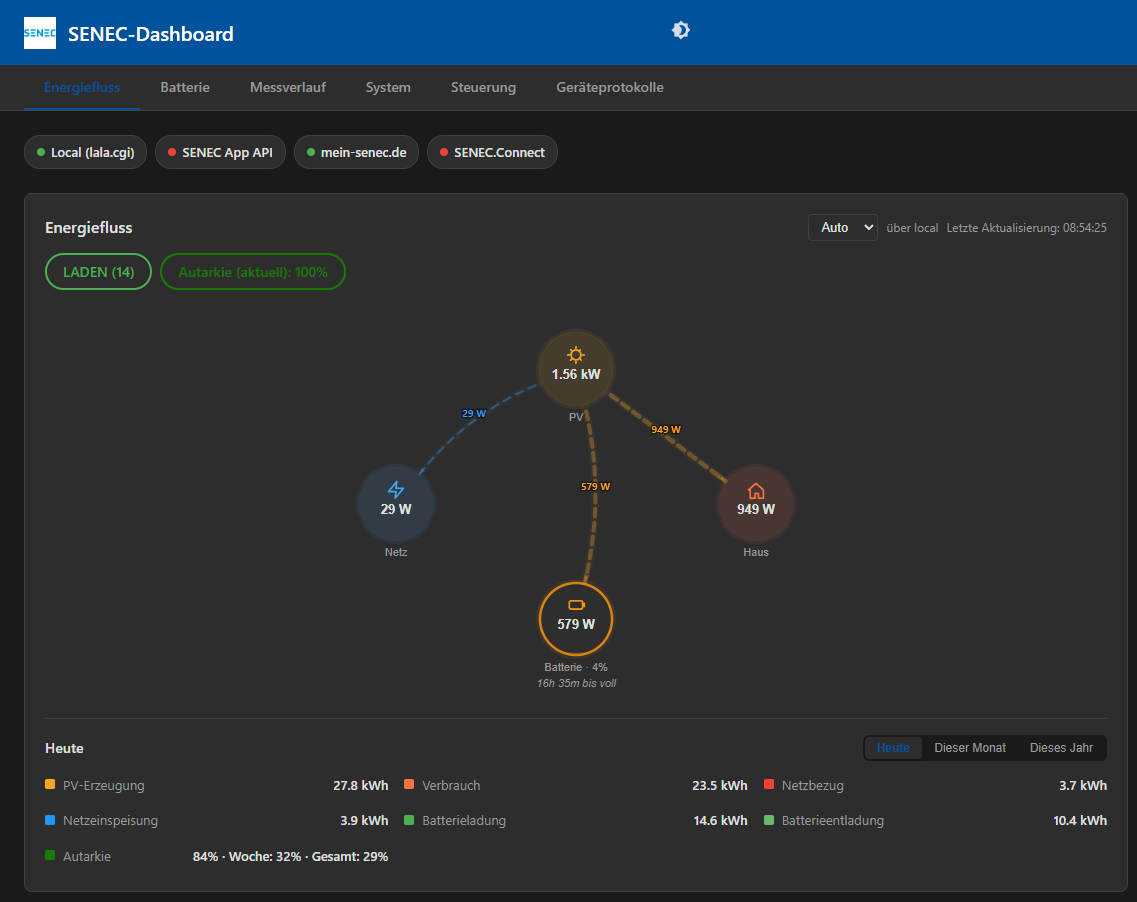
Energy Flow Diagram — Live SVG visualization showing power flow between PV, battery, grid, house, and wallbox. Animated curved paths with power-proportional thickness. Battery SOC gauge with fill level. Operating mode badge. Time estimates (until empty/full). Period totals (today/month/year) with autarky percentage. Data source selector (Auto/Local/API/Web).
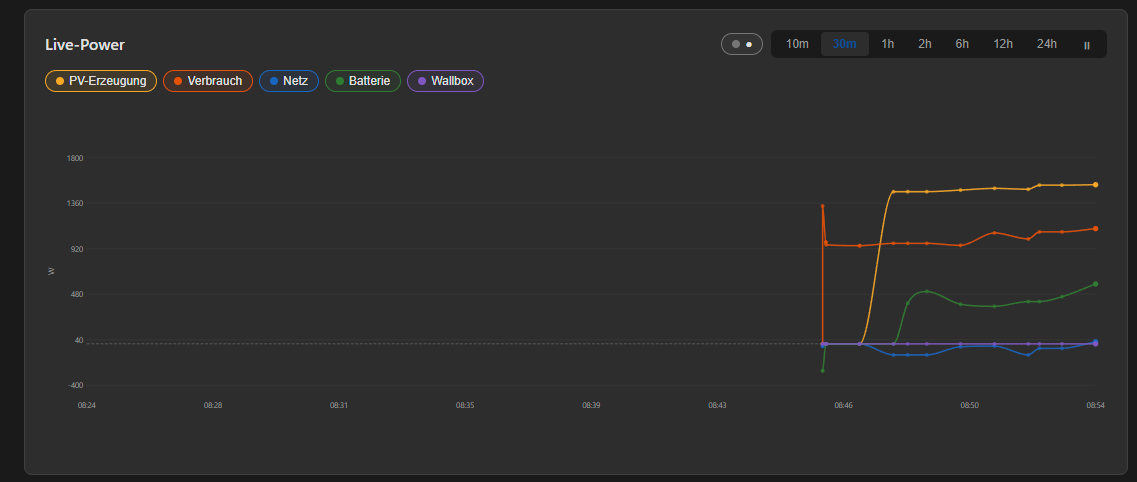
Live Power Curve — Real-time line chart showing power over time for all five metrics (PV, house, grid, battery, wallbox). Smooth monotone cubic interpolation between data points. Time window presets from 10 minutes to 24 hours, plus mouse wheel zoom (5min–30 days, downsampled for performance). Drag to pan through history with lazy loading and midnight date markers. Toggle individual lines, including an optional battery level line (off by default) drawn against its own right-hand 0–100 % axis. Pause/disable controls. Click "Live" to snap back to real-time. If a history adapter (InfluxDB, SQL, or History) is enabled on the power states, the chart backfills with historical data on page load. Each state is resolved on its own, so they may be recorded by different history adapters, and a state without recording only affects its own line. The ⓘ button lists the states behind every line together with the history adapter recording them — use it to find out why a line has no past data.
Event Timeline — Compact 24-hour strip showing today's warnings (orange), errors (red), and panics (purple) from the device log. Hover for full details. Auto-refreshes every 10 minutes. Requires the device IP to be configured.

Battery Tab
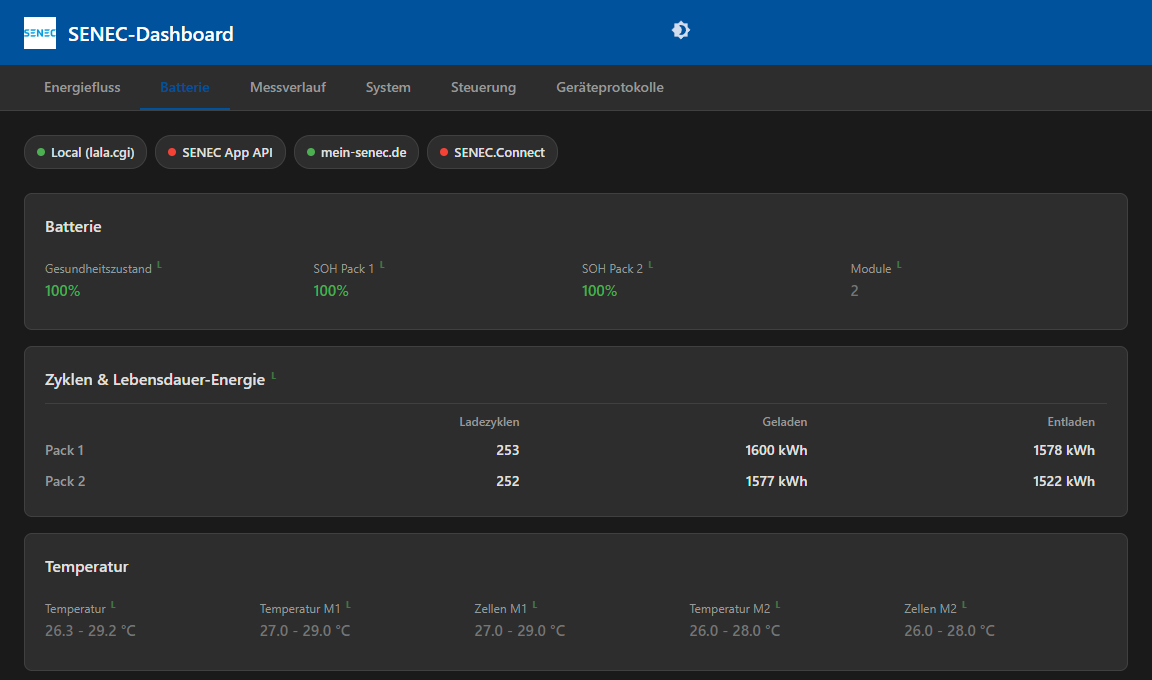
- State of Health — System and per-pack SOH with color-coded indicators (green > 80%, orange > 60%, red)
- Module Status — Active/charging/discharging module counts
- Charge Cycles — Per-pack cycle count and lifetime charged/discharged energy
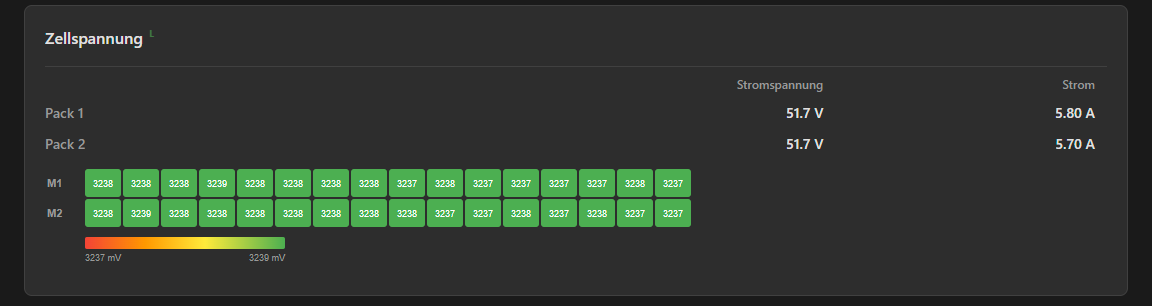
- Cell Voltage Heatmap — Color-coded grid showing individual cell voltages across all modules. Red = lowest, green = highest. Per-module delta indicators. Instantly reveals cell imbalance.
- Temperatures — Overall, per-module, and per-cell temperatures
- Pack Electrical — Per-pack voltage and current
Data sourced from Local (BMS) and/or API (SystemDetails) with source badges.
Charts Tab
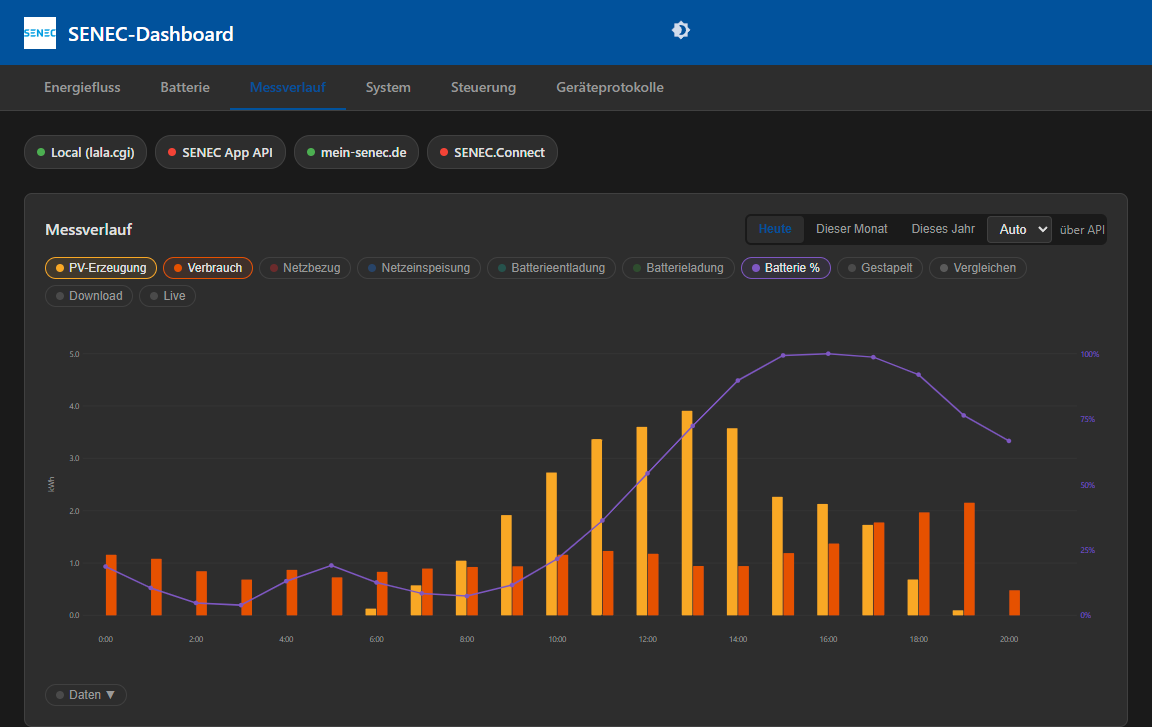
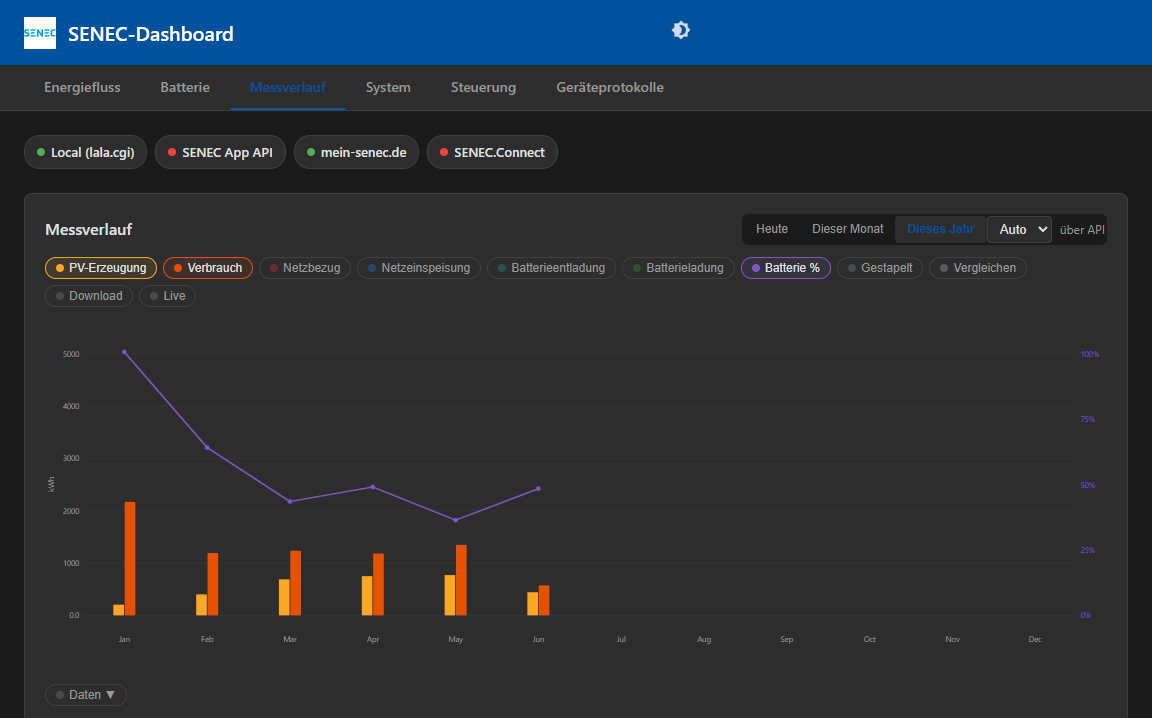
Measurement bar charts for energy data:
- Today — Hourly bars (auto-trims to hours with data)
- This Month — Daily bars
- This Year — Monthly bars
Features:
- Toggle individual measurement types (PV, consumption, grid import/export, battery charge/discharge)
- Stacked view (production vs. consumption)
- Comparison mode (yesterday, previous month, selectable year)
- Battery level (%) line overlay. The API connector reads it from the measurement history. mein-senec.de offers no such history, so the web connector samples the live charge level instead: hourly averages for the day view, daily averages for the month view. Those values therefore start when the adapter does — a day it was not running over midnight has no daily average, and none can be fetched retroactively. The year view has no battery level on the web connector.
- Data source selector (Auto/API/Web)
- Data table view
- PNG image export
- Auto-update mode
System Tab
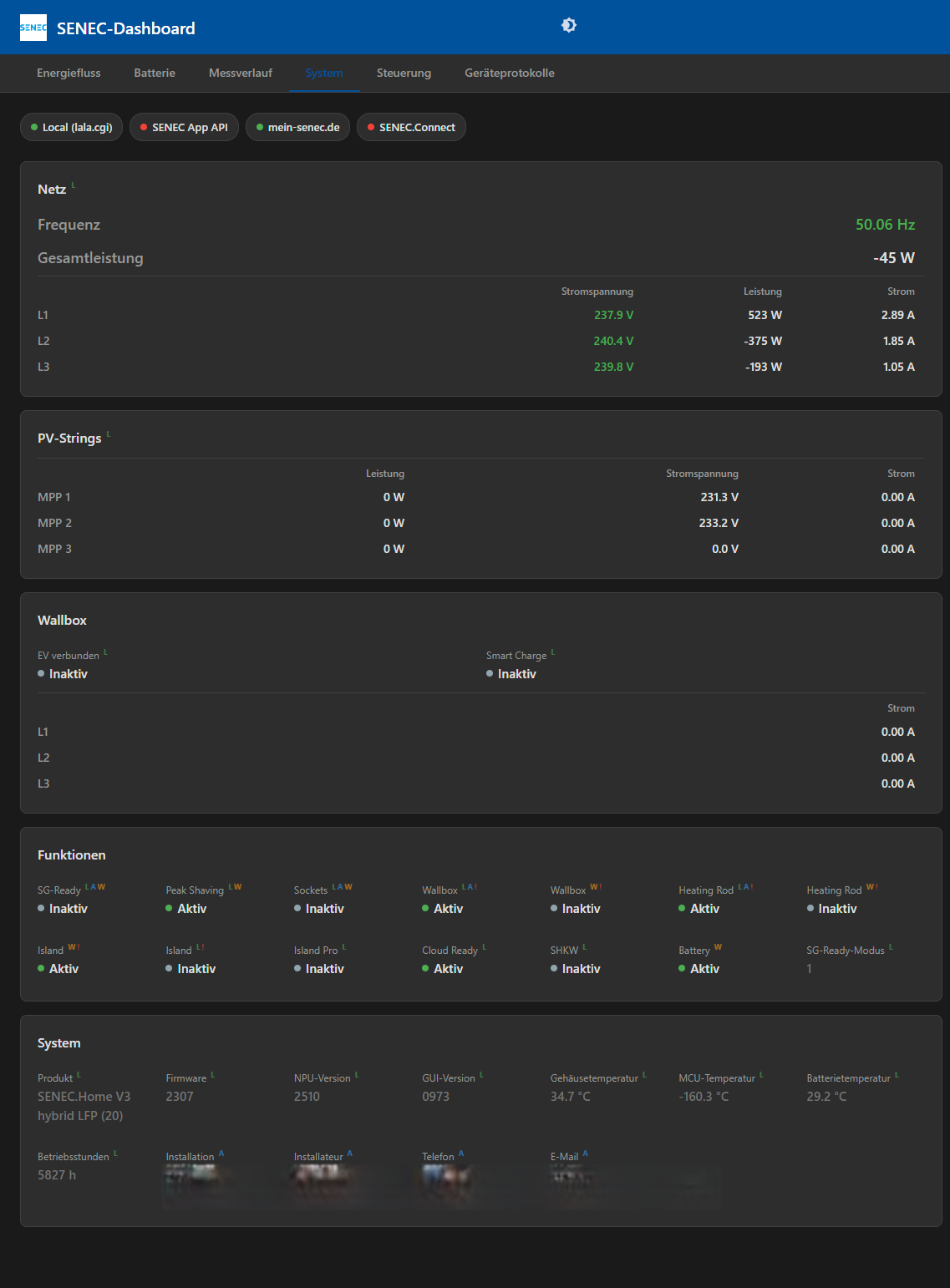
- Grid Quality — Frequency, total power, per-phase voltage/power/current. Supports EnFluRi 1 and EnFluRi 2 (auto-detected).
- PV Strings — Per-tracker MPP power, voltage, and current
- Wallbox — EV connected status, smart charge, per-phase charging current
- Feature Flags — Active features per connector with mismatch detection
- System Details — Product, firmware, GUI/NPU version, inverter state, temperatures (casing, MCU, battery, inverter), operating hours, installation date, installer contact
Source indicator badges show which connector provides each value.
Control Tab
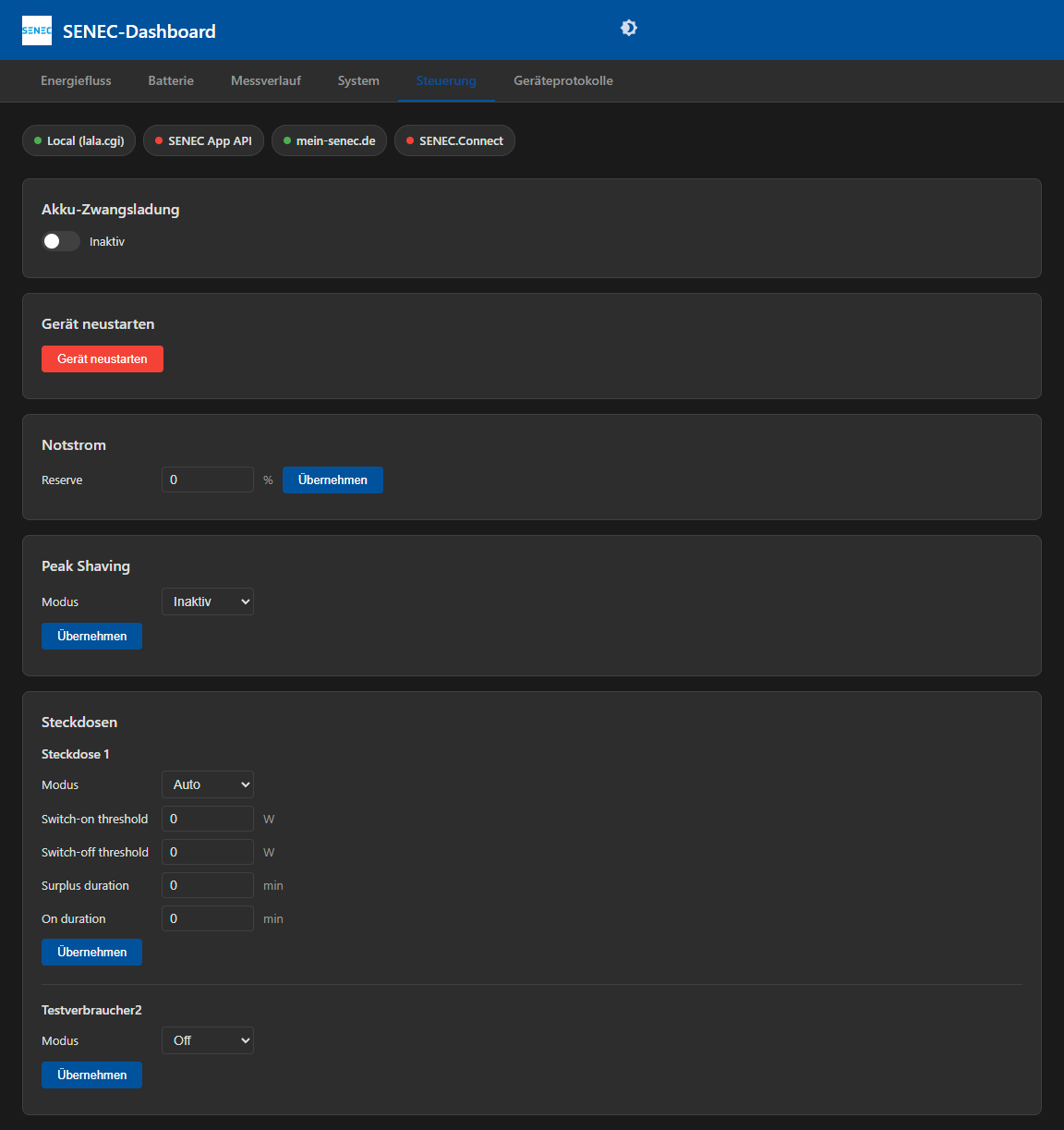
Interactive controls matching the adapter's control capabilities:
- Force battery charging (toggle)
- Appliance reboot (with confirmation dialog)
- Emergency power reserve (percentage slider)
- Peak shaving (mode-dependent fields)
- SG-Ready (enable + thresholds)
- Switchable sockets (per-socket mode, threshold settings, name editing)
- Wallbox (smart charge, current limit)
Controls check connector availability and show warnings if the required connector is not active. Apply button provides "Sent" confirmation feedback.
Statistics Tab
mein-senec.de keeps a weekly CSV export at 5-minute resolution going back years — far more data than belongs in ioBroker states. So nothing is persisted: the adapter stores only the list of available weeks, refreshed once a day, and downloads a single week on demand when you ask for it. The data lives only as long as the tab is open.
- Plant selector, listing previous appliances on the account as well (hidden when there is only one). The plant this instance polls is preselected.
- Week selector showing each week's date range
- Day filter — narrow a ~2,000-row week to a single day
- Resolution — hourly means or raw 5-minute rows
- Column toggles for the ten exported columns, including battery voltage, current and charge level
- Sortable headers; a third click restores chronological order
- Summary row with minimum, mean and maximum of the rows shown
- Table or chart view; in the chart, power columns share a left kW axis while percentages get their own right-hand 0–100 % axis, and gaps in a series break the line rather than being bridged
- Download the current selection as CSV
Requires the mein-senec.de connector to be enabled and connected.
Logs Tab
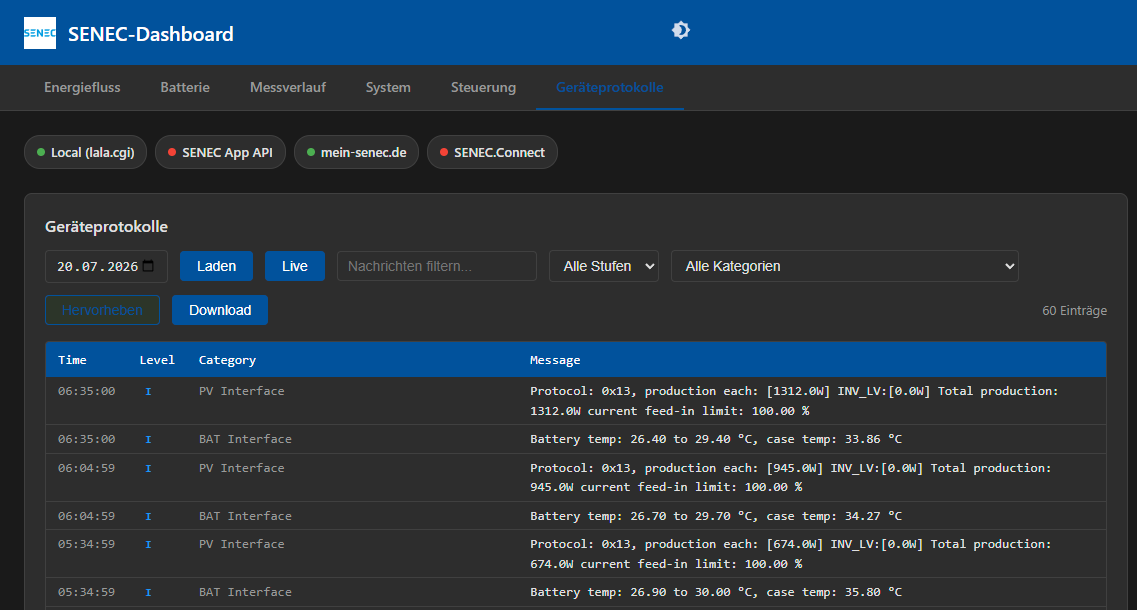
Browse SENEC device logs by date:
- Filterable table (Time, Level, Category, Message)
- Level filters: Info, Warning, Error, Panic
- Category filter (auto-populated from log entries)
- Free-text search
- Color-coded row highlighting by severity
- Newest entries first
- Live mode — auto-refreshes today's log (UTC-aware)
- Download raw log files
Requires the device IP to be configured (even if the Local connector is not enabled).
State Reference
The adapter creates states organized by connector and data section. All states are read-only unless explicitly marked as control states.
Connection & Status (info.*)
| State | Description |
|---|---|
info.connection | Overall connection status (true if any connector is active) |
info.connectionStatus | Detailed connection status: all (all configured connectors connected), partial (some connected), none |
info.localConnected | Local (lala.cgi) connection status |
info.apiConnected | SENEC App API connection status |
info.webConnected | mein-senec.de connection status |
info.connectConnected | SENEC.Connect connection status |
info.lastPoll.HighPrio | Timestamp of last high-priority local poll |
info.lastPoll.LowPrio | Timestamp of last low-priority local poll |
TLS States (_local.tls.*)
| State | Type | Write | Description |
|---|---|---|---|
_local.tls.mode | string | no | Active TLS validation mode: user, cached, tofu, or none |
_local.tls.fingerprint | string | no | SHA-256 fingerprint of the accepted device certificate (TOFU mode, encrypted) |
_local.tls.userCaPem | string | yes | User-uploaded CA certificate PEM (encrypted) |
_local.tls.cachedCaPem | string | no | CA certificate PEM downloaded from mein-senec.de (encrypted) |
_local.tls.certFetchFailed | boolean | yes | Set to false to trigger a new CA download attempt |
Local States
Data from lala.cgi polling is stored directly under the section name (e.g. ENERGY.*, BMS.*, PV1.*, WIZARD.*).
Key ENERGY states:
| State | Type | Description |
|---|---|---|
ENERGY.GUI_INVERTER_POWER | number (W) | Current PV generation |
ENERGY.GUI_BAT_DATA_POWER | number (W) | Battery power (positive = charging, negative = discharging) |
ENERGY.GUI_GRID_POW | number (W) | Grid power (positive = importing, negative = exporting) |
ENERGY.GUI_HOUSE_POW | number (W) | Current house consumption |
ENERGY.GUI_BAT_DATA_FUEL_CHARGE | number (%) | Battery state of charge |
ENERGY.STAT_STATE | number | System operating state code |
ENERGY.STAT_STATE_Text | string | System state in human-readable text |
ENERGY.STAT_HOURS_OF_OPERATION | number (h) | System uptime |
Key BMS states:
| State | Type | Description |
|---|---|---|
BMS.MODULE_COUNT | number | Number of battery modules |
BMS.SOH.{n} | number (%) | State of health per module |
BMS.CYCLES.{n} | number | Charge cycles per module |
BMS.CELL_VOLTAGES_MODULE_{A-D}.{n} | number (mV) | Individual cell voltages |
BMS.TEMP_MIN.{n} / BMS.TEMP_MAX.{n} | number (°C) | Module temperature range |
BMS.VOLTAGE.{n} / BMS.CURRENT.{n} | number (V/A) | Pack voltage and current |
API States (_api.*)
Cloud API data is stored under _api.Anlagen.{systemId}.*:
Dashboard.currently.*— Real-time power values (W)Measurements.Daily.*— Hourly measurement data (kWh)Measurements.Monthly.*— Daily measurement data (kWh)Measurements.Yearly.*— Monthly measurement data (kWh)Measurements.AllTime.*— Lifetime totals (kWh)SystemDetails.*— Battery details, temperatures, firmwareSystemStatus.*— Operating state, feature flags
Web States (_meinsenec.*)
mein-senec.de data is stored under _meinsenec.*:
Status.*— Current power values (kW), operating stateMeasurements.*— Historical measurement data (kWh)Autarky.*— Self-sufficiency percentages (day/week/month/year/all)EmergencyPower.*— Emergency power reserve settingsPeakShaving.*— Peak shaving configurationSGReady.*— SG-Ready settingsSockets.*— Switchable socket states
Connect States (_connect.*)
SENEC.Connect data is stored under _connect.Systems.{system_id}.* with battery and meter subsections. An account can hold more than one system; each one gets its own channel, named after its model and keyed on the system id reported in bessNameplate — so a system keeps its states even when the API returns the systems in a different order. _connect.info.systemCount reports how many systems the API sees.
The bessNameplate section is always requested, regardless of the configured sections, because it carries that id.
Wallboxes are stored the same way, under the id each one reports: _connect.Systems.{system_id}.evse.{wallbox_id}.*. A wallbox that disappears from the response has its states removed rather than left behind at their last values.
If a system reports no system_id, its serial number is used instead, and a system is remembered by every identifier it has ever reported — so a response that omits one of them does not move the system to a new path. If a response carries no identity at all, that system falls back to its position in the response, exactly as before 2.15.0, and cleanup is suspended for as long as this lasts.
States of a system the API no longer reports are removed. Adapters before 2.15.0 numbered the systems by their position in the response (_connect.Systems.0.*); those states are deleted on the first poll after the update, once the systems have been identified.
If you record SENEC.Connect states with a history adapter (History, InfluxDB, SQL), that setting lives on the state itself and is lost when the old state is deleted. Recording does not resume by itself — switch logging back on for the states under the new paths after updating.
External States (_external.*)
External source data is stored under _external.{type}.{index}.*:
| State | Description |
|---|---|
_external.pv.{n}.power | External PV power (W) |
_external.consumer.{n}.power | External consumer power (W) |
_external.battery.{n}.power | External battery power (W, signed) |
_external.battery.{n}.soc | External battery state of charge (%) |
_external.battery.{n}.capacity | External battery capacity (kWh) |
_external.{type}.{n}.label | User-defined label |
_external.{type}.{n}.mode | Display mode (integrate/separate) |
_external.{type}.{n}.sourceId | Foreign state ID or formula |
Control States (control.*)
Writable states for appliance control:
| State | Type | Description |
|---|---|---|
control.ForceCharge | boolean | Force battery charging on/off |
control.BlockDischarge | boolean | Block battery discharge on/off |
control.RebootAppliance | boolean | Trigger appliance reboot |
control.EmergencyPower.ReserveInPercent | number | Emergency power reserve (%) |
control.PeakShaving.* | various | Peak shaving settings |
control.SGReady.* | various | SG-Ready settings |
control.Sockets.{n}.* | various | Per-socket control |
control.Wallbox.{n}.* | various | Wallbox control |
Control states are only created when the corresponding feature is enabled and available via the configured connector.
Troubleshooting
Device not responding / frequent restarts: Reduce the high-priority polling interval or remove custom high-priority data points. The SENEC device has limited resources.
No data from API/Web: Check your mein-senec.de credentials in the SENEC Account tab. The adapter logs authentication errors at warning level.
Dashboard not loading: Ensure ioBroker.web is running on port 8082. The dashboard is served as a web extension at /senec/.
Missing states: Available states depend on your SENEC model, firmware version, and configured connectors. Not all states are available on all systems.
Control states not appearing: Control features must be explicitly enabled in the Appliance Control settings tab. Each control requires a specific connector to be active.
TLS certificate errors on local connection: The adapter handles certificate validation automatically. Check _local.tls.mode to see which validation method is active. If you see TOFU mode and want to upgrade to CA validation, enable the mein-senec.de connector — the adapter will attempt to download the CA cert automatically. If a previous download failed, set _local.tls.certFetchFailed to false to retry.
Getting Help
For questions, setups and comparing notes with other users, there is a dedicated thread in the ioBroker forum — mainly German, and usually the quickest way to an answer.
If something looks like a bug, open an issue on GitHub. Collecting a debug log and what makes a report actionable are described above.
Changelog
2.15.4 (2026-09-12)
- Dependency updates
2.15.3 (2026-08-31)
- Fix: The SENEC App API login posted only the fields it fills in itself and did not send back the hidden fields the login form contains. A browser sends those back, and the SSO uses them to carry the state of a login across its steps, so an account whose login takes a route that depends on them could not get past the first step. Every field of the form is now returned with the values the adapter supplies on top. This applies to the two-factor step as well, where the form names which of several configured codes is being answered.
- Fix: The mein-senec.de login had the same gap and now sends the form's hidden fields back as well. Its login-page debug dump is redacted before it is written, which it previously was not.
- Change: A login step that fails now records the page the SSO answered with, without Log requests and responses having to be switched on beforehand. The instance log level still has to be
debugor more verbose, and the adapter now checks that before it does the work — it previously prepared the page at every log level and then handed it to a call that discarded it. The one-line reason says which step failed but not what the SSO put in front of the adapter, which is where an unexpected login route shows itself, and by the time a report is written the login that produced it is gone, so it cannot be asked for afterwards. A login failing the same way on every retry writes the page once and afterwards only notes that it has not changed — the comparison now ignores the identifiers the SSO issues afresh for every attempt, which previously differed each time and defeated it. - Change: More of a logged login page is masked. Login codes are masked as hidden form values as well as in query strings, the account's mail address is masked in its plain, percent-encoded and HTML-entity-encoded spellings, and a password echoed back inside a form value is masked. The pages are shortened before they reach the log.
- Change: The short error text taken from a rejected login page now goes through the same masking as the debug page dump. It is logged at
errorlevel, so it is visible at the default log level — a wider audience than the page dump reaches, and until now it was the less thoroughly redacted of the two. - Change: With Log requests and responses switched on, the login form as it was served and the page after the username step are logged as well. These say nothing when a login works, so they stay behind the option.
2.15.2 (2026-08-28)
- Fix: A failing SENEC App API login reported nothing but
Request failed with status code 400— neither which of the four requests of the login had failed nor what the SSO had said about it, which is all the information there is. Every step of the login now names itself and repeats the reason the SSO gave, so a login that fails on one account but not on others can be told apart from an outage. - Fix: The request/response log (settings → SENEC App API → Log requests and responses) covered the data requests but not the login, so switching it on to investigate a login problem produced nothing about the login. It now logs each step of the SSO exchange as well, including where a redirect leads. Login codes are masked and neither credentials nor request bodies are ever written to the log.
- Change: A stored refresh token the SSO no longer accepts is an ordinary event — it happens whenever the session behind it has expired, and the full login that follows is the cure, not a symptom. It is no longer logged as a warning, so an ordinary re-login stops reading like a fault.
- Change: When the SSO ends the login somewhere other than the app itself — a further login step, or a refusal — the adapter now names the destination instead of reporting a missing authorization code.
- Dependency Updates
2.15.1 (2026-08-23)
- Dependency Updates
2.15.0 (2026-08-14)
- 🔎 Wanted: testers for the SENEC.Connect connector. I cannot see what your subscription returns, and real responses are what this connector is missing — especially from accounts holding more than one system, and from responses containing more than
batteryandmeter(evse,bessNameplate). If SENEC.Connect reports anything at all for your account, please get in touch in the ioBroker forum thread or via a GitHub issue. - Breaking (SENEC.Connect only): The systems of a SENEC.Connect account were stored by their position in the API response, as
_connect.Systems.0.*,_connect.Systems.1.*and so on. The API does not promise an order, so on an account with more than one system that position can change from one poll to the next — two systems then swap their states inside the same history, with nothing in the values to show it happened. Each system is now stored under the system id from itsbessNameplatesection instead, for example_connect.Systems.P4H1-1234567.*, and gets a channel named after its model. A system is remembered by every identifier it has ever reported, so a response that omits one of them does not move it; a system that reports no identity at all keeps its old position-based path and is left alone. The old numbered states are deleted on the first poll after the update; scripts, charts and visualisations that refer to them have to be pointed at the new paths, and the history recorded under the old paths ends there. If you log these states with a history adapter, that setting is stored on the state and does not survive the move — switch logging back on for the new paths, or recording stops silently. Accounts with a single system are affected the same way, but nothing else changes for them. - Breaking (SENEC.Connect only): Wallboxes are stored under the
idthey report rather than their position in the response, for the same reason and with the same consequence —_connect.Systems.{system_id}.evse.{wallbox_id}.*. A wallbox that disappears from the response now has its states removed instead of leaving them frozen at their last values, looking current. - New:
_connect.info.systemCountreports how many systems SENEC.Connect returns, and the states of a system the API stops reporting are removed. - New: SENEC.Connect has its own request timeout, adjustable between 5 and 120 seconds and 30 seconds by default. It previously borrowed the local appliance's timeout, which is capped at ten seconds and is not even shown unless the local connection is switched on — so a slow cloud response failed every poll with no reachable setting to change.
- Fix: A SENEC.Connect reply that arrived with a success code but did not contain the expected data — an error page or a captive portal, for instance — left the connector reporting itself as connected indefinitely while nothing was being read.
- Fix: A SENEC.Connect polling interval outside the permitted range is corrected on start-up, as the other intervals already were. Only a value written directly into the instance settings could get there, but a negative one made the adapter poll a request-metered API in a tight loop.
- Fix: A SENEC.Connect request in progress is now cancelled when the adapter stops, instead of running on and writing during shutdown, and it identifies itself with the same user agent as the adapter's other requests.
- Fix: Clearing the SENEC.Connect section list in the settings fell back to fewer sections than the field's own default, silently dropping wallbox data.
- Change: The
bessNameplatesection is now always requested from SENEC.Connect regardless of the configured sections, because it carries the id the states are stored under. The API is billed per request, not per section, so this costs nothing. - Fix: When mein-senec.de measurement detail states were cleared at the daily rollover and written again in the same cycle, they came back as bare values — the name, unit and role were gone, because the adapter still believed the deleted definitions existed.
- Fix: On appliances not set to German,
ENERGY.STAT_STATE_Textwas never created at all. It puts the numeric system state into plain language — "Laden", "Akku voll", "Fernabschaltung" — but the English and Italian tables were stored under a name the adapter never looked them up by, so nothing was written and no error appeared. English is also what the adapter falls back to when it cannot read the appliance's language, so this affected most installations. The state now appears; on an affected system it shows up as a new datapoint after the update.FACTORY.COUNTRY_Textwas missing on Italian appliances for the same reason. - Fix: System state 41 was labelled "Schlafmodus" / "Sleeping mode". The appliance itself calls it "Abschaltung Lithium" / "Lithium shutdown", which is a different condition; the Italian text already said so. State 74 also carried a spelling mistake.
- New: Three more numeric datapoints are translated into text —
BMS.MANUFACTURER_Textnames the battery module generation (BMZ or Ampace / LFP),PWR_UNIT.ENFLURI_Textsays which meter a power unit is measured by, andCASC.STATE_Textgives the cascade state. - Change: A datapoint your appliance does not have no longer gets a state, and an existing one says so. The adapter asks every appliance for the same set of datapoints and no model provides all of them, so the answer "I do not have that one" is normal rather than a fault. Until now that answer was stored as the value, so the state read
VARIABLE_NOT_FOUND. No state is created for it any more, and one that already exists is set to "not provided by appliance" so it is obvious at a glance instead of sitting there with a stale number that still looks current. Nothing is deleted, nothing is reported as a problem, and nothing is required of you. A datapoint that merely failed to be read this once is left untouched, because the real reading is expected back. A whole section your appliance does not have is handled the same way; it previously left behind a state called<SECTION>.OBJECT_NOT_FOUNDholding nothing. This covers what the adapter asks for by name and the sections it requests — a field that quietly vanishes from a section still being provided cannot be detected this way, because the appliance simply omits it rather than saying anything about it. - Fix: An unreadable datapoint could be published as a real-looking measurement. The appliance answers with a word where a number was expected, and that word slipped into the conversions for flags, factors, dates and IP addresses: a flag was stored as
true, a scaled value asNaN, a timestamp as "Invalid Date" and an address as garbage. Nothing is stored for such an answer any more, so a state either holds a real reading or does not exist. A datapoint answering with an empty value no longer becomes0either, and a few value formats the appliance uses were decoded wrongly — text beginning with "u" could be read as a number, so a state could show 14 where the appliance had sent no reading at all. - Change:
ENERGY.GUI_BAT_DATA_OA_CHARGINGis no longer polled every few seconds. A SENEC.Home V3 does not have it, it is absent from every field that appliance reports for this section, and the appliance's own web interface never asks for it. It remains defined, so an older appliance that still provides it keeps the state from the slower poll. - Fix: The appliance's display language was read once at start-up, in a race with the first poll of the datapoint that carries it. On a fresh installation the adapter could therefore stay on English for the whole session, and changing the language on the appliance never took effect until the adapter was restarted. It is now picked up as soon as the appliance reports it, and a language the adapter has no texts for falls back to English instead of silently leaving every translated state empty.
- Fix: A code that is not in a translation table was shown as "(unknown)", which discarded the very number needed to identify it. It now reads "(unknown 7)". If you see one, the number is worth reporting.
- Change: Translated
_Textstates are no longer marked writable — writing to them never did anything — and are declared as text rather than as a measurement. Existing ones are corrected on the first poll after the update. - Fix: The operating-mode text on the web dashboard now comes from the appliance's own system state on English and Italian systems as well. It previously fell back to the cloud status text there, because the local text did not exist.
- Fix: Several labels in the English and Italian system-state lists were misspelled, one Italian entry contained a stray fragment of an untranslated string, and some Italian entries were missing their accents.
- Change: The adapter warns when the datapoints configured for high-priority polling make a request large enough to approach the size the appliance can still answer. Beyond that size the appliance replies with a truncated body, which used to surface only as a connection error.
Former Updates
License
MIT License
Copyright (c) 2020-2026 Norbert Bluemle github@bluemle.org
Permission is hereby granted, free of charge, to any person obtaining a copy of this software and associated documentation files (the "Software"), to deal in the Software without restriction, including without limitation the rights to use, copy, modify, merge, publish, distribute, sublicense, and/or sell copies of the Software, and to permit persons to whom the Software is furnished to do so, subject to the following conditions:
The above copyright notice and this permission notice shall be included in all copies or substantial portions of the Software.
THE SOFTWARE IS PROVIDED "AS IS", WITHOUT WARRANTY OF ANY KIND, EXPRESS OR IMPLIED, INCLUDING BUT NOT LIMITED TO THE WARRANTIES OF MERCHANTABILITY, FITNESS FOR A PARTICULAR PURPOSE AND NONINFRINGEMENT. IN NO EVENT SHALL THE AUTHORS OR COPYRIGHT HOLDERS BE LIABLE FOR ANY CLAIM, DAMAGES OR OTHER LIABILITY, WHETHER IN AN ACTION OF CONTRACT, TORT OR OTHERWISE, ARISING FROM, OUT OF OR IN CONNECTION WITH THE SOFTWARE OR THE USE OR OTHER DEALINGS IN THE SOFTWARE.